EN

Hearing Aid Channels: An 8–32-Channel B2B Guide for Distributors & OEM/ODM Buyers
2026/10/16
Learn how to compare 8, 12, 16, 24 and 32-channel hearing aid platforms for distributors, importers, OEM/ODM and private-label projects.
2026/10/21
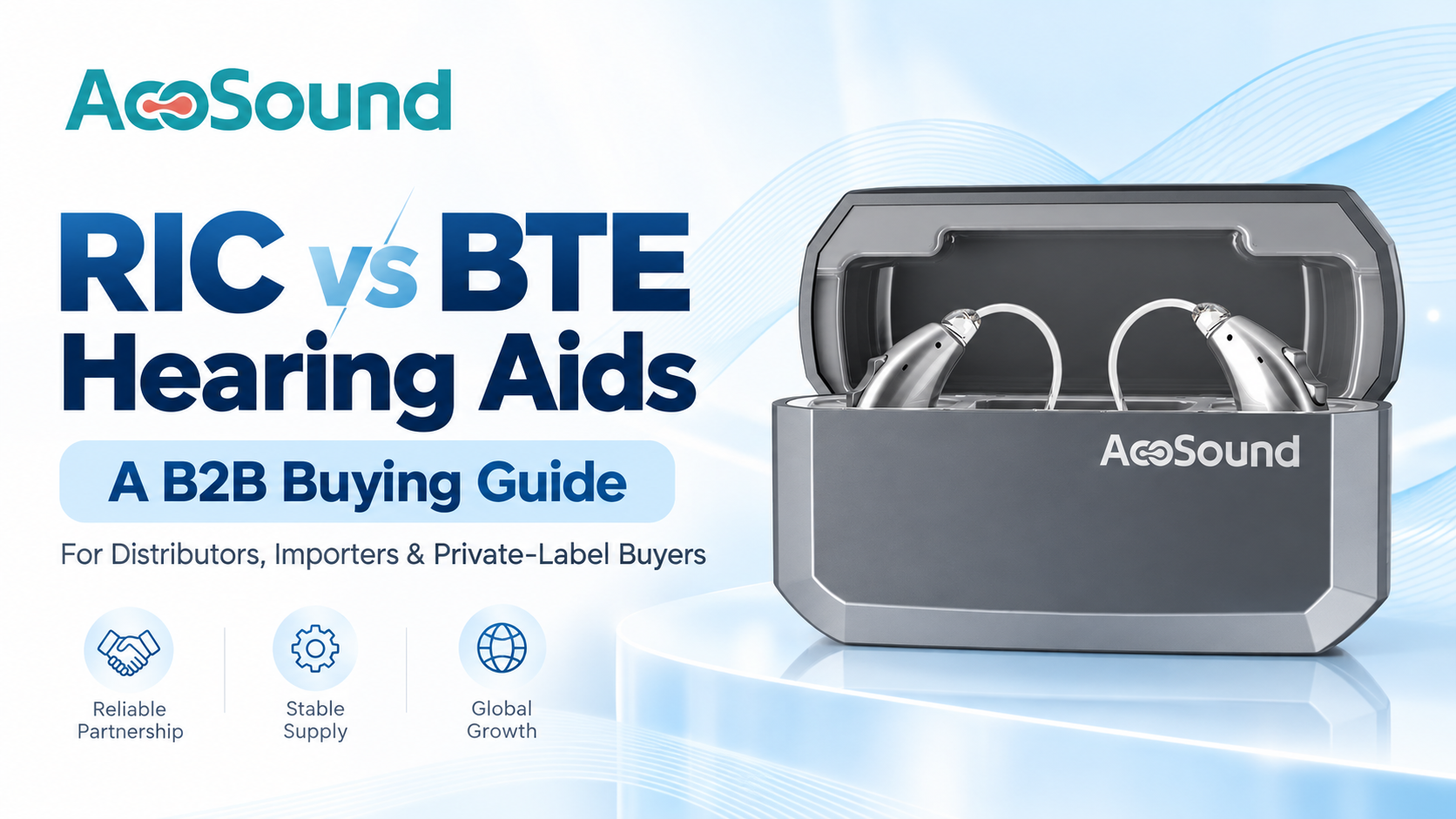
Choosing between RIC and BTE hearing aids is a common decision for distributors building or updating their product ranges. Both designs have established uses in the hearing aid market, but they differ in construction, maintenance, fitting options, and the way they fit into a commercial product portfolio.
For an importer or private-label brand, the decision involves more than appearance. Product reliability, spare-part availability, fitting requirements, target pricing, and after-sales support can all affect the long-term value of a product.
So, when comparing RIC vs BTE hearing aids, where should buyers start? The first step is to understand how the two designs differ and then assess which one makes more sense for the customers they serve.
RIC stands for receiver-in-canal. The main housing sits behind the ear, while the receiver is placed inside the ear canal and connected to the housing by a thin wire.
This design allows for a relatively compact housing and gives manufacturers flexibility when developing different product configurations. Depending on the model, receiver power options and coupling choices may also be available.
There are practical considerations, however. Because the receiver sits in the ear canal, wax protection, moisture exposure, and receiver replacement deserve attention. For a distributor, these details matter beyond the initial sale. They can influence accessory stocking, service procedures, and the cost of supporting customers over time.
Before selecting a RIC model, check the available receiver options, compatible domes or other coupling components, replacement-part availability, and fitting software. It is also worth confirming how the supplier handles receiver-related warranty claims.
BTE means behind-the-ear. In a traditional BTE design, the main components are housed behind the ear, and sound is delivered through tubing to an earmold.
BTE products come in different sizes and configurations. Their output, fitting options, controls, and power capabilities depend on the individual model, so the category name alone does not tell a buyer everything they need to know.
One practical advantage of a traditional BTE configuration is that its tubing and earmold arrangement can be familiar to hearing care professionals. These components also need regular attention, particularly when tubing becomes worn or blocked.
When sourcing BTE products, ask about tubing and earmold compatibility, available power configurations, replacement parts, and the maintenance instructions supplied with the device. If your customers work directly with hearing care professionals, confirm that the fitting workflow and product documentation suit their needs.
The main differences are easier to evaluate when they are considered alongside the requirements of the intended market.
| Factor | RIC Hearing Aids | BTE Hearing Aids |
|---|---|---|
| Design | Receiver sits in the ear canal, connected by a wire | Main components sit behind the ear; traditional models use tubing |
| Appearance | Often has a compact housing and thin wire | Housing and sound-delivery components may be more visible |
| Maintenance | Receiver, wax protection, and moisture management | Tubing, earmold, and sound outlet maintenance may be relevant |
| Configuration | Depends on receiver and coupling options | Depends on model, tubing, earmold, and power options |
| Spare parts | Receivers and compatible accessories | Tubing, earmolds, and model-specific components |
| Purchasing considerations | Receiver supply, compatibility, and replacement costs | Accessory availability, maintenance, and configuration options |
These are general design differences, not a universal ranking. A well-specified BTE model may suit a particular application better than a RIC model, and the reverse can also be true. The actual datasheet should guide the comparison.
A distributor serving hearing care professionals may have different priorities from an importer supplying several retail channels. That difference should shape the product selection.
Start with the customers. Find out which designs are already familiar in your market, what fitting options local professionals expect, and which price ranges generate demand. If your existing customers regularly request a particular form factor, that is a useful starting point for evaluating suppliers.
Then consider the total cost. The purchase price is only one part of the calculation. Receivers, tubing, earmolds, chargers, batteries, warranty replacements, and service requirements can all affect the economics of a product. Compare these costs over the expected sales and support period, not just at the quotation stage.
Check the technical configuration. RIC and BTE describe physical designs; they do not define the complete signal-processing capability. Review the fitting channels, adjustable bands, DSP architecture, feedback management, noise processing, and fitting software of each model. Products with the same form factor can still differ considerably in their functions and specifications.
Finally, consider whether the supplier can maintain a consistent supply of the selected model and its compatible accessories. A product that sells well but is difficult to service can create avoidable problems for both the distributor and the end customer.
A useful supplier comparison starts with the same questions for every candidate product.
First, request the full technical datasheet. Confirm the electroacoustic specifications, available configurations, fitting options, and included accessories. If a supplier uses terms such as “advanced noise reduction” or “adaptive feedback cancellation,” ask for the relevant specifications and product documentation rather than relying on marketing descriptions alone.
Next, arrange samples for evaluation. Check the physical design, controls, fitting workflow, software, and overall build quality. Where appropriate, involve the hearing care professionals who will fit or service the products. Their feedback can reveal practical issues that are difficult to assess from a catalogue.
Spare parts deserve a separate discussion. Ask which components are replaceable, how compatible parts are identified, whether they are stocked regularly, and what the normal replenishment lead time is. Clarify the warranty process before commercial orders begin.
For larger orders, confirm the minimum order quantity (MOQ), production lead time, packaging requirements, payment terms, and arrangements for handling quality issues. Buyers importing medical devices should also verify the documentation, labeling, and regulatory requirements applicable to their destination market.
There is no need for every distributor to choose just one design. In some markets, carrying both RIC and BTE products makes it easier to serve different customer groups.
A practical way to plan the range is to begin with the needs of your existing customers. Identify the main price segments, the product functions they request, and the service resources available to support them. Then select models that provide meaningful differences rather than adding products that compete with one another without a clear reason.
For example, a distributor might begin with one core RIC model and one BTE model, then expand after reviewing sales performance, customer feedback, and service costs. The final mix should reflect actual demand and the supplier's ability to provide consistent products and parts.
This approach also gives sales teams a clearer explanation of why each model belongs in the catalogue. The distinction should be based on documented specifications, design, available configurations, and intended market position—not simply on the assumption that one format is more advanced.
A suitable supplier should provide more than a product list. Technical documentation, sample support, replacement components, production planning, and responsive after-sales service all affect the success of a distribution partnership.
AcoSound's product portfolio includes RIC, BTE, and ITE hearing aid categories. Buyers can review the available models and compare their documented specifications before deciding which products match their market requirements.
Explore the AcoSound hearing aid product range to review available models. For projects involving branding, packaging, accessories, or other agreed customization, visit the AcoSound OEM/ODM page.
If you are developing a private-label range, discuss the intended market, required product configurations, customization scope, sample arrangements, and expected order volume with the supplier before finalizing the project.
RIC and BTE hearing aids serve different product and fitting requirements. RIC designs place the receiver in the ear canal, while traditional BTE designs house the main components behind the ear and deliver sound through tubing. Neither format is automatically the better choice for every market.
For distributors and importers, a sound purchasing decision comes from comparing the complete product specification, maintenance requirements, accessory supply, commercial terms, and supplier support.
Before placing an order, define what your customers need, compare representative samples, and confirm that the supplier can support the product after delivery. That process provides a more reliable basis for building a sustainable hearing aid portfolio than choosing by appearance or price alone.
2026/10/16
Learn how to compare 8, 12, 16, 24 and 32-channel hearing aid platforms for distributors, importers, OEM/ODM and private-label projects.
2026/10/14
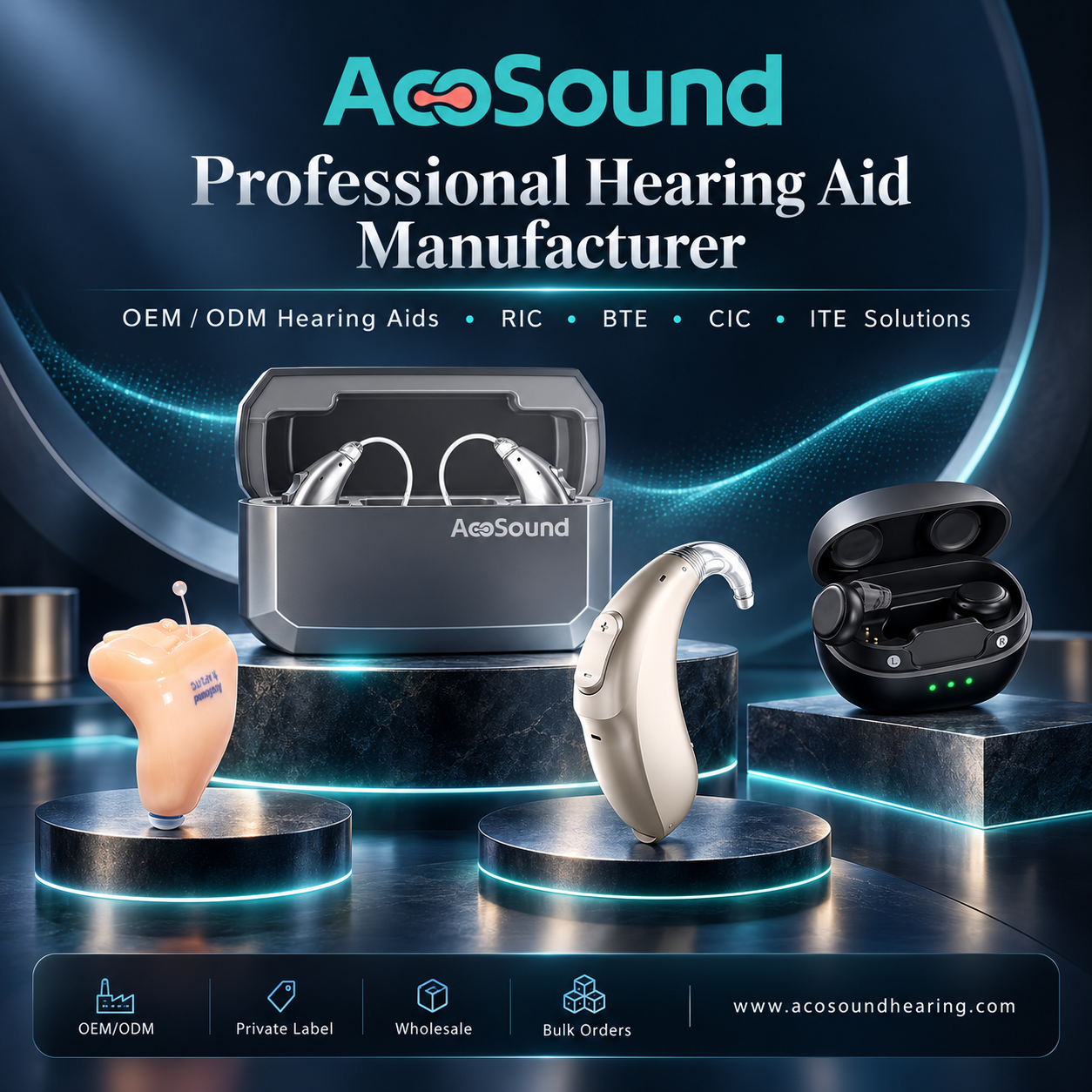
Learn how to source wholesale hearing aids, compare RIC and BTE models, evaluate suppliers, and plan OEM/ODM orders with AcoSound.

2025/03/10
AcoSound, a smart hearing aid manufacturer, showcased rechargeable hearing aids, Bluetooth technology and intelligent fitting solutions at Guangzhou Expo 2025.

2025/05/27
AcoSound advances China-UAE hearing technology cooperation through joint R&D, local production and long-term assistive technology partnership in the UAE.